Section 1.10 : Common Graphs
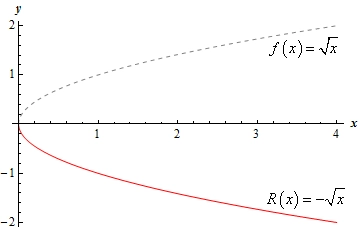
9. Without using a graphing calculator sketch the graph of \(R\left( x \right) = - \sqrt x \).
Hint : Recall that the graph of \( - f\left( x \right)\) is the graph of \(f\left( x \right)\) reflected about the \(x\)-axis.
Show Solution
Recall the basic Algebraic transformations. If we know the graph of \(f\left( x \right)\) then the graph of \( - f\left( x \right)\) is simply the graph of \(f\left( x \right)\) reflected about the \(x\)-axis.
So, in our case if \(f\left( x \right) = \sqrt x \) we can see that,
\[R\left( x \right) = - \sqrt x = - f\left( x \right)\]and so the graph we’re being asked to sketch is the graph of the square root function reflected about the \(x\)-axis.
Here is the graph of \(R\left( x \right) = - \sqrt x \) (the solid curve) and note that to help see the transformation we have also sketched in the graph of \(f\left( x \right) = \sqrt x \) (the dashed curve).