Section 2.3 : One-Sided Limits
1. Below is the graph of \(f\left( x \right)\). For each of the given points determine the value of \(f\left( a \right)\), \(\mathop {\lim }\limits_{x \to {a^{\, - }}} f\left( x \right)\), \(\mathop {\lim }\limits_{x \to {a^{\, + }}} f\left( x \right)\), and \(\mathop {\lim }\limits_{x \to a} f\left( x \right)\). If any of the quantities do not exist clearly explain why.
- \(a = - 4\)
- \(a = - 1\)
- \(a = 2\)
- \(a = 4\)
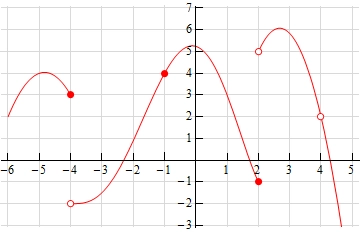
Show All Solutions Hide All Solutions
a \(a = - 4\) Show Solution
From the graph we can see that,
\[\require{bbox} \bbox[2pt,border:1px solid black]{{f\left( { - 4} \right) = 3}}\]because the closed dot is at the value of \(y = 3\).
We can also see that as we approach \(x = - 4\) from the left the graph is approaching a value of 3 and as we approach from the right the graph is approaching a value of -2. Therefore, we get,
\[\require{bbox} \bbox[4pt,border:1px solid black]{{\mathop {\lim }\limits_{x \to \, - {4^{\, - }}} f\left( x \right) = 3\hspace{0.25in}\hspace{0.25in}\& \hspace{0.25in}\mathop {\lim }\limits_{x \to \, - {4^{\, + }}} f\left( x \right) = - 2}}\]Now, because the two one-sided limits are different we know that,
\[\require{bbox} \bbox[2pt,border:1px solid black]{{\mathop {\lim }\limits_{x \to \, - 4} f\left( x \right)\,\,{\mbox{does not exist}}}}\]b \(a = - 1\) Show Solution
From the graph we can see that,
\[\require{bbox} \bbox[2pt,border:1px solid black]{{f\left( { - 1} \right) = 4}}\]because the closed dot is at the value of \(y = 4\).
We can also see that as we approach \(x = - 1\) from both sides the graph is approaching the same value, 4, and so we get,
\[\require{bbox} \bbox[4pt,border:1px solid black]{{\mathop {\lim }\limits_{x \to \, - {1^{\, - }}} f\left( x \right) = 4\hspace{0.25in}\hspace{0.25in}\& \hspace{0.25in}\mathop {\lim }\limits_{x \to \, - {1^{\, + }}} f\left( x \right) = 4}}\]The two one-sided limits are the same so we know,
\[\require{bbox} \bbox[2pt,border:1px solid black]{{\mathop {\lim }\limits_{x \to \, - 1} f\left( x \right) = 4}}\]c \(a = 2\) Show Solution
From the graph we can see that,
\[\require{bbox} \bbox[2pt,border:1px solid black]{{f\left( 2 \right) = - 1}}\]because the closed dot is at the value of \(y = - 1\).
We can also see that as we approach \(x = 2\) from the left the graph is approaching a value of -1 and as we approach from the right the graph is approaching a value of 5. Therefore, we get,
\[\require{bbox} \bbox[4pt,border:1px solid black]{{\mathop {\lim }\limits_{x \to \,{2^{\, - }}} f\left( x \right) = - 1\hspace{0.25in}\hspace{0.25in}\& \hspace{0.25in}\mathop {\lim }\limits_{x \to \,{2^{\, + }}} f\left( x \right) = 5}}\]Now, because the two one-sided limits are different we know that,
\[\require{bbox} \bbox[2pt,border:1px solid black]{{\mathop {\lim }\limits_{x \to \,2} f\left( x \right)\,\,{\mbox{does not exist}}}}\]d \(a = 4\) Show Solution
Because there is no closed dot for \(x = 4\) we can see that,
\[\require{bbox} \bbox[2pt,border:1px solid black]{{f\left( 4 \right)\,\,\,{\mbox{does not exist}}}}\]We can also see that as we approach \(x = 4\) from both sides the graph is approaching the same value, 2, and so we get,
\[\require{bbox} \bbox[4pt,border:1px solid black]{{\mathop {\lim }\limits_{x \to \,{4^{\, - }}} f\left( x \right) = 2\hspace{0.25in}\hspace{0.25in}\& \hspace{0.25in}\mathop {\lim }\limits_{x \to \,{4^{\, + }}} f\left( x \right) = 2}}\]The two one-sided limits are the same so we know,
\[\require{bbox} \bbox[2pt,border:1px solid black]{{\mathop {\lim }\limits_{x \to \,4} f\left( x \right) = 2}}\]Always recall that the value of a limit (including one-sided limits) does not actually depend upon the value of the function at the point in question. The value of a limit only depends on the values of the function around the point in question. Therefore, even though the function doesn’t exist at this point the limit and one-sided limits can still have a value.