Section 12.4 : Quadric Surfaces
1. Sketch the following quadric surface.
\[\frac{{{y^2}}}{9} + {z^2} = 1\]Show Solution
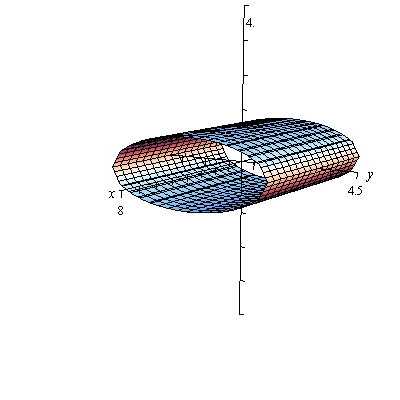
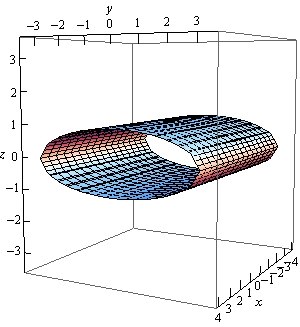
This is a cylinder that is centered on the \(x\)-axis. The cross sections of the cylinder will be ellipses.
Make sure that you can “translate” the equations given in the notes to the other coordinate axes. Once you know what they look like when centered on one of the coordinates axes then a simple and predictable variable change will center them on the other coordinate axes.
Here are a couple of sketches of the region. We’ve given them with the more traditional axes as well as “boxed” axes to help visualize the surface.