Section 1.8 : Logarithm Functions
In this section we’ll take a look at a function that is related to the exponential functions we looked at in the last section. We will look at logarithms in this section. Logarithms are one of the functions that students fear the most. The main reason for this seems to be that they simply have never really had to work with them. Once they start working with them, students come to realize that they aren’t as bad as they first thought.
We’ll start with \(b > 0\), \(b \ne 1\) just as we did in the last section. Then we have
\[y = {\log _b}x\hspace{0.5in}{\mbox{is equivalent to }}\hspace{0.5in}x = {b^y}\]The first is called logarithmic form and the second is called the exponential form. Remembering this equivalence is the key to evaluating logarithms. The number, \(b\), is called the base.
Let's do some quick evaluations.
- \({\log _2}16\)
- \({\log _4}16\)
- \({\log _5}625\)
- \({\log _9}\frac{1}{{531441}}\)
- \({\log _{\frac{1}{6}}}36\)
- \({\log _{\frac{3}{2}}}\frac{{27}}{8}\)
To quickly evaluate logarithms the easiest thing to do is to convert the logarithm to exponential form. So, let’s take a look at the first one.
a \({\log _2}16\) Show SolutionFirst, let’s convert to exponential form.
\[{\log _2}16 = ?\hspace{0.5in}{\mbox{is equivalent to }}\hspace{0.5in}{2^?} = 16\]So, we’re really asking 2 raised to what gives 16. Since 2 raised to 4 is 16 we get,
\[{\log _2}16 = 4\hspace{0.5in}{\rm{because}}\hspace{0.5in}{2^4} = 16\]We’ll not do the remaining parts in quite this detail, but they will all work in this way.
b \({\log _4}16\) Show Solution
Note the difference between the first and second logarithm! The base is important! It can completely change the answer.
c \({\log _5}625\) Show Solution
d \({\log _9}\frac{1}{{531441}}\) Show Solution
e \({\log _{\frac{1}{6}}}36\) Show Solution
f \({\log _{\frac{3}{2}}}\frac{{27}}{8}\) Show Solution
There are a couple of special logarithms that arise in many places. These are,
\[\begin{align*}\ln x & = {\log _{\bf{e}}}x\hspace{0.5in}{\mbox{This log is called the natural logarithm}}\\ \log x & = {\log _{10}}x\hspace{0.5in}{\mbox{This log is called the common logarithm}}\end{align*}\]In the natural logarithm the base e is the same number as in the natural exponential function that we saw in the last section. Here is a sketch of both of these logarithms.
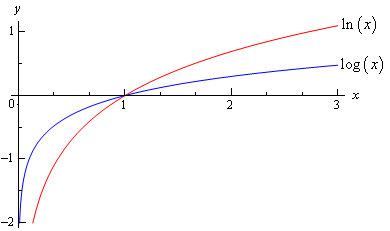
From this graph we can get a couple of very nice properties about the natural logarithm that we will use many times in this and later Calculus courses.
\[\begin{array}{l}\ln x \to \infty {\mbox{ as }}x \to \infty \\ \ln x \to - \infty {\mbox{ as }}x \to 0,\,\,x > 0\end{array}\]Let’s take a look at a couple of more logarithm evaluations. Some of which deal with the natural or common logarithm and some of which don’t.
- \(\ln \sqrt[3]{{\bf{e}}}\)
- \(\log 1000\)
- \({\log _{16}}16\)
- \({\log _{23}}1\)
- \({\log _2}\sqrt[7]{{32}}\)
These work exactly the same as previous example so we won’t put in too many details.
a \(\ln \sqrt[3]{{\bf{e}}}\) Show Solutionb \(\log 1000\) Show Solution
c \({\log _{16}}16\) Show Solution
d \({\log _{23}}1\) Show Solution
e \({\log _2}\sqrt[7]{{32}}\) Show Solution
This last set of examples leads us to some of the basic properties of logarithms.
Properties
- The domain of the logarithm function is \(\left( {0,\infty } \right)\). In other words, we can only plug positive numbers into a logarithm! We can’t plug in zero or a negative number.
- The range of the logarithm function is \(\left( { - \infty ,\infty } \right)\).
- \({\log _b}b = 1\)
- \({\log _b}1 = 0\)
- \({\log _b}{b^x} = x\)
- \({b^{{{\log }_b}x}} = x\)
The last two properties will be especially useful in the next section. Notice as well that these last two properties tell us that,
\[f\left( x \right) = {b^x}\hspace{0.5in}{\rm{and }}\hspace{0.5in}g\left( x \right) = {\log _b}x\]are inverses of each other.
Here are some more properties that are useful in the manipulation of logarithms.
More Properties
- \({\log _b} (xy) = {\log _b}(x) + {\log _b}(y)\)
- \(\displaystyle {\log _b}\left( {\frac{x}{y}} \right) = {\log _b}(x) - {\log _b}(y)\)
- \({\log _b}\left( {{x^r}} \right) = r{\log _b}(x)\)
Note that there is no equivalent property to the first two for sums and differences. In other words,
\[\begin{align*}{\log _b}\left( {x + y} \right) & \ne {\log _b}x + {\log _b}y\\ {\log _b}\left( {x - y} \right) & \ne {\log _b}x - {\log _b}y\end{align*}\]- \(\ln \left({x^3}{y^4}{z^5}\right)\)
- \(\displaystyle {\log _3}\left( {\frac{{9{x^4}}}{{\sqrt y }}} \right)\)
- \(\displaystyle \log \left( {\frac{{{x^2} + {y^2}}}{{{{\left( {x - y} \right)}^3}}}} \right)\)
What the instructions really mean here is to use as many of the properties of logarithms as we can to simplify things down as much as we can.
a \(\ln \left({x^3}{y^4}{z^5}\right)\) Show SolutionProperty 7 above can be extended to products of more than two functions. Once we’ve used Property 7 we can then use Property 9.
\[\begin{align*} \ln \left({x^3}{y^4}{z^5}\right) & = \ln (x^3) + \ln (y^4) + \ln (z^5) \\ & = 3\ln (x) + 4\ln (y) + 5\ln (z) \end{align*}\]b \(\displaystyle {\log _3}\left( {\frac{{9{x^4}}}{{\sqrt y }}} \right)\) Show Solution
When using property 8 above make sure that the logarithm that you subtract is the one that contains the denominator as its argument. Also, note that that we’ll be converting the root to fractional exponents in the first step.
\[\begin{align*} {\log _3}\left( {\frac{{9{x^4}}}{{\sqrt y }}} \right) & = {\log _3}(9{x^4}) - {\log _3}({y^{\frac{1}{2}}}) \\ & = {\log _3}(9) + {\log _3}(x^4) - {\log _3}(y^{\frac{1}{2}}) \\ & = 2 + 4\log _{3}(x) - \frac{1}{2}\log_{3}(y) \end{align*}\]c \(\displaystyle \log \left( {\frac{{{x^2} + {y^2}}}{{{{\left( {x - y} \right)}^3}}}} \right)\) Show Solution
The point to this problem is mostly the correct use of property 9 above.
\[\begin{align*}\log \left( {\frac{{{x^2} + {y^2}}}{{{{\left( {x - y} \right)}^3}}}} \right) & = \log \left( {{x^2} + {y^2}} \right) - \log {\left( {x - y} \right)^3}\\ & = \log \left( {{x^2} + {y^2}} \right) - 3\log \left( {x - y} \right)\end{align*}\]You can use Property 9 on the second term because the WHOLE term was raised to the 3, but in the first logarithm, only the individual terms were squared and not the term as a whole so the 2’s must stay where they are!
The last topic that we need to look at in this section is the change of base formula for logarithms. The change of base formula is,
\[{\log _b}x = \frac{{{{\log }_a}x}}{{{{\log }_a}b}}\]This is the most general change of base formula and will convert from base \(b\) to base \(a\). However, the usual reason for using the change of base formula is to compute the value of a logarithm that is in a base that you can’t easily deal with. Using the change of base formula means that you can write the logarithm in terms of a logarithm that you can deal with. The two most common change of base formulas are
\[{\log _b}x = \frac{{\ln x}}{{\ln b}}\hspace{0.5in}{\rm{and}}\hspace{0.5in}{\rm{lo}}{{\rm{g}}_{\rm{b}}}x = \frac{{\log x}}{{\log b}}\]In fact, often you will see one or the other listed as THE change of base formula!
In the first part of this section we computed the value of a few logarithms, but we could do these without the change of base formula because all the arguments could be written in terms of the base to a power. For instance,
\[{\log _7}49 = 2\hspace{0.5in}{\rm{because}}\hspace{0.5in}{7^2} = 49\]However, this only works because 49 can be written as a power of 7! We would need the change of base formula to compute \({\log _7}50\).
\[{\log _7}50 = \frac{{\ln 50}}{{\ln 7}} = \frac{{3.91202300543}}{{1.94591014906}} = 2.0103821378\]OR
\[{\log _7}50 = \frac{{\log 50}}{{\log 7}} = \frac{{1.69897000434}}{{0.845098040014}} = 2.0103821378\]So, it doesn’t matter which we use, we will get the same answer regardless of the logarithm that we use in the change of base formula.
Note as well that we could use the change of base formula on \({\log _7}49\) if we wanted to as well.
\[{\log _7}49 = \frac{{\ln 49}}{{\ln 7}} = \frac{{3.89182029811}}{{1.94591014906}} = 2\]This is a lot of work however, and is probably not the best way to deal with this.
So, in this section we saw how logarithms work and took a look at some of the properties of logarithms. We will run into logarithms on occasion so make sure that you can deal with them when we do run into them.