4. Polar & Exponential Form
Most people are familiar with complex numbers in the form \(z = a + bi\), however there are some alternate forms that are useful at times. In this section we’ll look at both of those as well as a couple of nice facts that arise from them.
Geometric Interpretation
Before we get into the alternate forms we should first take a very brief look at a natural geometric interpretation of complex numbers since this will lead us into our first alternate form.
Consider the complex number \(z = a + bi\). We can think of this complex number as either the point \(\left( {a,b} \right)\) in the standard Cartesian coordinate system or as the vector that starts at the origin and ends at the point \(\left( {a,b} \right)\). An example of this is shown in the figure below.
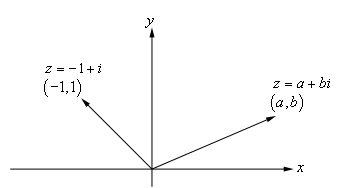
In this interpretation we call the \(x\)-axis the real axis and the \(y\)-axis the imaginary axis. We often call the \(xy\)-plane in this interpretation the complex plane.
Note as well that we can now get a geometric interpretation of the modulus. From the image above, we can see that \(\left| z \right| = \sqrt {{a^2} + {b^2}} \) is nothing more than the length of the vector that we’re using to represent the complex number \(z = a + bi\). This interpretation also tells us that the inequality \(\left| {{z_1}} \right| < \left| {{z_2}} \right|\) means that \({z_1}\) is closer to the origin (in the complex plane) than \({z_2}\) is.
Polar Form
Let’s now take a look at the first alternate form for a complex number. If we think of the non-zero complex number \(z = a + bi\) as the point \(\left( {a,b} \right)\) in the \(xy\)-plane we also know that we can represent this point by the polar coordinates \(\left( {r,\theta } \right)\), where \(r\) is the distance of the point from the origin and \(\theta \) is the angle, in radians, from the positive \(x\)-axis to the ray connecting the origin to the point.
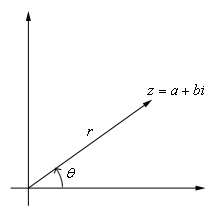
When working with complex numbers we assume that \(r\) is positive and that \(\theta \) can be any of the possible (both positive and negative) angles that end at the ray. Note that this means that there are literally an infinite number of choices for \(\theta \).
We excluded \(z = 0\) since \(\theta \) is not defined for the point (0,0). We will therefore only consider the polar form of non-zero complex numbers.
We have the following conversion formulas for converting the polar coordinates \(\left( {r,\theta } \right)\) into the corresponding Cartesian coordinates of the point, \(\left( {a,b} \right)\).
\[a = r\cos \theta \hspace{0.75in} b = r\sin \theta \]If we substitute these into \(z = a + bi\) and factor an \(r\) out we arrive at the polar form of the complex number,
\begin{equation}z = r\left( {\cos \theta + i\sin \theta } \right) \label{eq:eq1}\end{equation}Note as well that we also have the following formula from polar coordinates relating \(r\) to \(a\) and \(b\).
\[r = \sqrt {{a^2} + {b^2}} \]but, the right side is nothing more than the definition of the modulus and we see that,
\begin{equation}r = \left| z \right|\label{eq:eq2} \end{equation}So, sometimes the polar form will be written as,
\begin{equation}z = \left| z \right|\left( {\cos \theta + i\sin \theta } \right)\label{eq:eq3}\end{equation}The angle \(\theta \) is called the argument of \(z\) and is denoted by,
\[\theta = \arg z\]The argument of \(z\) can be any of the infinite possible values of \(\theta \) each of which can be found by solving
\begin{equation}\tan \theta = \frac{b}{a}\label{eq:eq4}\end{equation}and making sure that \(\theta \) is in the correct quadrant.
Note as well that any two values of the argument will differ from each other by an integer multiple of \(2\pi \). This makes sense when you consider the following.
For a given complex number \(z\) pick any of the possible values of the argument, say \(\theta \). If you now increase the value of \(\theta \), which is really just increasing the angle that the point makes with the positive \(x\)-axis, you are rotating the point about the origin in a counter-clockwise manner. Since it takes \(2\pi \) radians to make one complete revolution you will be back at your initial starting point when you reach \(\theta + 2\pi \) and so have a new value of the argument. See the figure below.
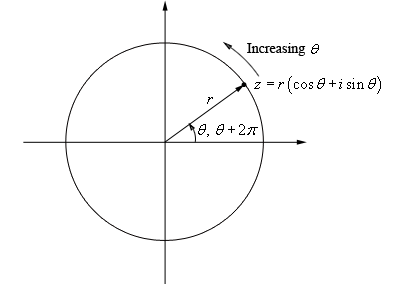
If you keep increasing the angle you will again be back at the starting point when you reach \(\theta + 4\pi \), which is again a new value of the argument. Continuing in this fashion we can see that every time we reach a new value of the argument we will simply be adding multiples of \(2\pi \) onto the original value of the argument.
Likewise, if you start at \(\theta \) and decrease the angle you will be rotating the point about the origin in a clockwise manner and will return to your original starting point when you reach \(\theta - 2\pi \). Continuing in this fashion and we can again see that each new value of the argument will be found by subtracting a multiple of \(2\pi \) from the original value of the argument.
So, we can see that if \({\theta _1}\) and \({\theta _2}\) are two values of \(\arg z\) then for some integer \(k\) we will have,
\begin{equation}{\theta _1} - {\theta _2} = 2\pi k\label{eq:eq5}\end{equation}Note that we’ve also shown here that \(z = r\left( {\cos \theta + i\sin \theta } \right)\) is a parametric representation for a circle of radius \(r\) centered at the origin and that it will trace out a complete circle in a counter-clockwise direction as the angle increases from \(\theta \) to \(\theta + 2\pi \).
The principal value of the argument (sometimes called the principal argument) is the unique value of the argument that is in the range \( - \pi < \arg z \le \pi \) and is denoted by \({\mathop{\rm Arg}\nolimits} z\). Note that the inequalities at either end of the range tells that a negative real number will have a principal value of the argument of \({\mathop{\rm Arg}\nolimits} z = \pi \).
Recalling that we noted above that any two values of the argument will differ from each other by a multiple of \(2\pi \) leads us to the following fact.
\begin{equation}\arg z = {\mathop{\rm Arg}\nolimits} z + 2\pi n \hspace{0.25in} n = 0, \pm 1, \pm 2, \ldots \label{eq:eq:6}\end{equation}We should probably do a couple of quick numerical examples at this point before we move on to look the second alternate form of a complex number.
- \(z = - 1 + i\,\sqrt 3 \)
- \(z = - 9 \)
- \(z = 12\,i\)
Now let’s find the argument of \(z\). This can be any angle that satisfies \(\eqref{eq:eq4}\), but it’s usually easiest to find the principal value so we’ll find that one. The principal value of the argument will be the value of \(\theta \) that is in the range \( - \pi < \theta \le \pi \), satisfies,
\[\tan \theta = \frac{{\sqrt 3 }}{{ - 1}} \hspace{0.25in} \Rightarrow \hspace{0.25in} \theta = {\tan ^{ - 1}}\left( { - \sqrt 3 } \right)\]and is in the second quadrant since that is the location the complex number in the complex plane.
If you’re using a calculator to find the value of this inverse tangent make sure that you understand that your calculator will only return values in the range \( - \frac{\pi }{2} < \theta < \frac{\pi }{2}\) and so you may get the incorrect value. Recall that if your calculator returns a value of \({\theta _1}\) then the second value that will also satisfy the equation will be \({\theta _2} = {\theta _1} + \pi \). So, if you’re using a calculator be careful. You will need to compute both and the determine which falls into the correct quadrant to match the complex number we have because only one of them will be in the correct quadrant.
In our case the two values are,
\[{\theta _1} = - \frac{\pi }{3} \hspace{0.25in} {\theta _2} = - \frac{\pi }{3} + \pi = \frac{{2\pi }}{3}\]The first one is in quadrant four and the second one is in quadrant two and so is the one that we’re after. Therefore, the principal value of the argument is,
\[{\mathop{\rm Arg}\nolimits} \,z = \frac{{2\pi }}{3}\]and all possible values of the argument are then
\[\arg z = \frac{{2\pi }}{3} + 2\pi n \hspace{0.25in} n = 0, \pm 1, \pm 2, \ldots \]Now, let’s actually do what we were originally asked to do. Here is the polar form of \(z = - 1 + i\,\sqrt 3 \).
\[z = 2\left( {\cos \left( {\frac{{2\pi }}{3}} \right) + i\sin \left( {\frac{{2\pi }}{3}} \right)} \right)\]Now, for the sake of completeness we should acknowledge that there are many more equally valid polar forms for this complex number. To get any of the other forms we just need to compute a different value of the argument by picking \(n\). Here are a couple of other possible polar forms.
\begin{align*}z & = 2\left( {\cos \left( {\frac{{8\pi }}{3}} \right) + i\sin \left( {\frac{{8\pi }}{3}} \right)} \right) & \hspace{0.25in} & n = 1\\ z & = 2\left( {\cos \left( { - \frac{{16\pi }}{3}} \right) + i\sin \left( { - \frac{{16\pi }}{3}} \right)} \right) & \hspace{0.25in} & n = - 3\end{align*}b \(z = - 9 \) Show Solution
In this case we’ve already noted that the principal value of a negative real number is \(\pi \) so we don’t need to compute that. For completeness sake here are all possible values of the argument of any negative number.
\[\arg z = \pi + 2\pi n = \pi \left( {1 + 2n} \right) \hspace{0.25in} n = 0, \pm 1, \pm 2, \ldots \]Now, \(r\) is,
\[r = \left| z \right| = \sqrt {81 + 0} = 9\]The polar form (using the principal value) is,
\[z = 9\left( {\cos \left( \pi \right) + i\sin \left( \pi \right)} \right)\]Note that if we’d had a positive real number the principal value would be \({\mathop{\rm Arg}\nolimits}\, z = 0\)
c \(z = 12\,i\) Show Solution
This another special case much like real numbers. If we were to use \(\eqref{eq:eq4}\) to find the argument we would run into problems since the real part is zero and this would give division by zero. However, all we need to do to get the argument is think about where this complex number is in the complex plane. In the complex plane purely imaginary numbers are either on the positive \(y\)-axis or the negative \(y\)-axis depending on the sign of the imaginary part.
For our case the imaginary part is positive and so this complex number will be on the positive \(y\)-axis. Therefore, the principal value and the general argument for this complex number is,
\[{\mathop{\rm Arg}\nolimits} z = \frac{\pi }{2} \hspace{0.5in} \arg z = \frac{\pi }{2} + 2\pi n = \pi \left( {\frac{1}{2} + 2n} \right) \hspace{0.25in} n = 0, \pm 1, \pm 2, \ldots \]Also, in this case \(r\) = 12 and so the polar form (again using the principal value) is,
\[z = 12\left( {\cos \left( {\frac{\pi }{2}} \right) + i\sin \left( {\frac{\pi }{2}} \right)} \right)\]Exponential Form
Now that we’ve discussed the polar form of a complex number we can introduce the second alternate form of a complex number. First, we’ll need Euler’s formula,
\begin{equation}{{\bf{e}}^{i\,\theta }} = \cos \theta + i\sin \theta \label{eq:eq7}\end{equation}With Euler’s formula we can rewrite the polar form of a complex number into its exponential form as follows.
\[z = r{{\bf{e}}^{i\,\theta }}\]where \(\theta = \arg z\) and so we can see that, much like the polar form, there are an infinite number of possible exponential forms for a given complex number. Also, because any two arguments for a give complex number differ by an integer multiple of \(2\pi \) we will sometimes write the exponential form as,
\[z = r{{\bf{e}}^{i\,\left( {\theta + 2\pi n} \right)}} \hspace{0.25in} n = 0, \pm 1, \pm 2, \ldots \]where \(\theta \) is any value of the argument although it is more often than not the principal value of the argument.
To get the value of \(r\) we can either use \(\eqref{eq:eq3}\) to write the exponential form or we can take a more direct approach. Let’s take the direct approach. Take the modulus of both sides and then do a little simplification as follows,
\[\left| z \right| = \left| {r{{\bf{e}}^{i\,\theta }}} \right| = \left| r \right|\,\left| {{{\bf{e}}^{i\,\theta }}} \right| = \left| r \right|\,\left| {\cos \theta + i\sin \theta } \right| = \sqrt {{r^2} + 0} \,\,\sqrt {{{\cos }^2}\theta + {{\sin }^2}\theta } = r\]and we see that \(r = \left| z \right|\).
Note as well that because we can consider \(z = r\left( {\cos \theta + i\sin \theta } \right)\) as a parametric representation of a circle of radius \(r\) and the exponential form of a complex number is really another way of writing the polar form we can also consider \(z = r{{\bf{e}}^{i\,\theta }}\) a parametric representation of a circle of radius \(r\).
Now that we’ve got the exponential form of a complex number out of the way we can use this along with basic exponent properties to derive some nice facts about complex numbers and their arguments.
First, let’s start with the non-zero complex number \(z = r{{\bf{e}}^{i\,\theta }}\). In the arithmetic section we gave a fairly complex formula for the multiplicative inverse, however, with the exponential form of the complex number we can get a much nicer formula for the multiplicative inverse.
\[{z^{ - 1}} = {\left( {r{{\bf{e}}^{i\,\theta }}} \right)^{ - 1}} = {r^{ - 1}}{\left( {{{\bf{e}}^{i\,\theta }}} \right)^{ - 1}} = {r^{ - 1}}{{\bf{e}}^{ - i\,\theta }} = \frac{1}{r}{{\bf{e}}^{i\,\left( { - \theta } \right)}}\]Note that since \(r\) is a non-zero real number we know that \({r^{ - 1}} = \frac{1}{r}\). So, putting this together the exponential form of the multiplicative inverse is,
\begin{equation}{z^{ - 1}} = \frac{1}{r}{{\bf{e}}^{i\,\left( { - \theta } \right)}}\label{eq:eq8}\end{equation}and the polar form of the multiplicative inverse is,
\begin{equation}{z^{ - 1}} = \frac{1}{r}\left( {\cos \left( { - \theta } \right) + i\sin \left( { - \theta } \right)} \right)\label{eq:eq9}\end{equation}We can also get some nice formulas for the product or quotient of complex numbers. Given two complex numbers \({z_1} = {r_1}\,{{\bf{e}}^{i\,{\theta _{\,1}}}}\) and \({z_2} = {r_2}\,{{\bf{e}}^{i\,{\theta _{\,2}}}}\), where \({\theta _1}\) is any value of \(\arg {z_1}\) and \({\theta _2}\) is any value of \(\arg {z_2}\), we have
\begin{align}{z_1}{z_2} &= \left( {{r_1}\,{{\bf{e}}^{i\,{\theta _{\,1}}}}} \right)\left( {{r_2}\,{{\bf{e}}^{i\,{\theta _{\,2}}}}} \right) = {r_1}\,{r_2}{{\bf{e}}^{i\,\left( {{\theta _{\,1}} + {\theta _{\,2}}} \right)}}\label{eq:eq10}\\ & \nonumber \\ \frac{{{z_1}}}{{{z_2}}} &= \frac{{{r_1}\,{{\bf{e}}^{i\,{\theta _{\,1}}}}}}{{{r_2}\,{{\bf{e}}^{i\,{\theta _{\,2}}}}}} = \frac{{{r_1}}}{{{r_2}}}{{\bf{e}}^{i\,\left( {{\theta _{\,1}}\, - \,\,{\theta _{\,2}}} \right)}}\label{eq:eq11}\end{align}The polar forms for both of these are,
\begin{align}{z_1}{z_2} & = {r_1}\,{r_2}\left( {\cos \left( {{\theta _{\,1}} + {\theta _{\,2}}} \right) + i\sin \left( {{\theta _{\,1}} + {\theta _{\,2}}} \right)} \right)\label{eq:eq12} \\ & \nonumber \\ \frac{{{z_1}}}{{{z_2}}} & = \frac{{{r_1}}}{{{r_2}}}\left( {\cos \left( {{\theta _{\,1}}\, - \,\,{\theta _{\,2}}} \right) + i\sin \left( {{\theta _{\,1}}\, - \,\,{\theta _{\,2}}} \right)} \right)\label{eq:eq13}\end{align}We can also use \(\eqref{eq:eq10}\) and \(\eqref{eq:eq11}\) to get some nice facts about the arguments of a product and a quotient of complex numbers. Since \({\theta _1}\) is any value of \(\arg {z_1}\) and \({\theta _2}\) is any value of \(\arg {z_2}\) we can see that,
\begin{align}\arg \left( {{z_1}\,{z_2}} \right) & = \arg {z_1} + \arg {z_2}\label{eq:eq14} \\ & \nonumber \\ \arg \left( {\frac{{{z_1}}}{{{z_2}}}} \right) & = \arg {z_1} - \arg {z_2}\label{eq:eq15} \end{align}Note that \(\eqref{eq:eq14}\) and \(\eqref{eq:eq15}\) may or may not work if you use the principal value of the argument, \({\rm{Arg }}\,z\). For example, consider \({z_1} = i\) and \({z_2} = - 1\). In this case we have \({z_1}{z_2} = - i\) and the principal value of the argument for each is,
\[{\mathop{\rm Arg}\nolimits} \left( i \right) = \frac{\pi }{2} \hspace{0.5in} {\mathop{\rm Arg}\nolimits} \left( { - 1} \right) = \pi \hspace{0.5in} {\mathop{\rm Arg}\nolimits} \left( { - i} \right) = - \frac{\pi }{2}\]However,
\[{\mathop{\rm Arg}\nolimits} \left( i \right) + {\mathop{\rm Arg}\nolimits} \left( { - 1} \right) = \frac{{3\pi }}{2} \ne - \frac{\pi }{2}\]and so \(\eqref{eq:eq14}\) doesn’t hold if we use the principal value of the argument. Note however, if we use,
\[\arg \left( i \right) = \frac{\pi }{2} \hspace{0.5in}\arg \left( { - 1} \right) = \pi \]then,
\[\arg \left( i \right) + \arg \left( { - 1} \right) = \frac{{3\pi }}{2}\]is valid since \(\frac{{3\pi }}{2}\) is a possible argument for –\(i\), it just isn’t the principal value of the argument.
As an interesting side note, \(\eqref{eq:eq15}\) actually does work for this example if we use the principal arguments. That won’t always happen, but it does in this case so be careful!
We will close this section with a nice fact about the equality of two complex numbers that we will make heavy use of in the next section. Suppose that we have two complex numbers given by their exponential forms, \({z_1} = {r_1}\,{{\bf{e}}^{i\,{\theta _{\,1}}}}\) and \({z_2} = {r_2}\,{{\bf{e}}^{i\,{\theta _{\,2}}}}\). Also suppose that we know that \({z_1} = {z_2}\). In this case we have,
\[{r_1}\,{{\bf{e}}^{i\,{\theta _{\,1}}}} = {r_2}\,{{\bf{e}}^{i\,{\theta _{\,2}}}}\]Then we will have \({z_1} = {z_2}\) if and only if,
\begin{equation}{r_1} = {r_2} \hspace{0.25in} {\rm{and}} \hspace{0.25in} {\theta _2} = {\theta _1} + 2\pi k\,\,\,{\mbox{for some integer }}k{\rm{ }}\left( {i.e.\,\,k = 0, \pm 1, \pm 2, \ldots } \right)\label{eq:eq16}\end{equation}Note that the phrase “if and only if” is a fancy mathematical phrase that means that if \({z_1} = {z_2}\) is true then so is \(\eqref{eq:eq16}\) and likewise, if \(\eqref{eq:eq16}\) is true then we’ll have \({z_1} = {z_2}\).
This may seem like a silly fact, but we are going to use this in the next section to help us find the powers and roots of complex numbers.