Section 4.8 : Rational Functions
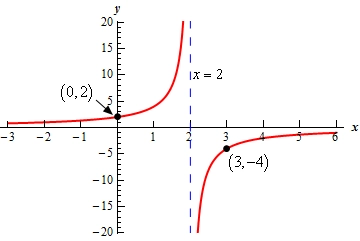
1. Sketch the graph of the following function. Clearly identify all intercepts and asymptotes.
\[f\left( x \right) = \frac{{ - 4}}{{x - 2}}\]Show All Steps Hide All Steps
Start Solution
Let’s first find the intercepts for this function.
The \(y\)-intercept is the point \(\left( {0,f\left( 0 \right)} \right) = \left( {0,2} \right)\).
For the \(x\)-intercepts we set the numerator equal to zero and solve. However, in this case the numerator is a constant (-4 specifically) and so can’t ever be zero. Therefore, this function will have no \(x\)-intercepts.
Show Step 2
We can find any vertical asymptotes be setting the denominator equal to zero and solving. Doing that for this function gives,
\[x - 2 = 0\hspace{0.25in} \to \hspace{0.25in}x = 2\]So, we’ll have a vertical asymptote at \(x = 2\).
Show Step 3
For this equation the largest exponent of \(x\) in the numerator is zero since the numerator is a constant. The largest exponent of \(x\) in the denominator is 1, which is larger than the largest exponent in the numerator, and so the \(x\)-axis will be the horizontal asymptote.
Show Step 4
From Step 2 we saw we only have one vertical asymptote and so we only have two regions to our graph : \(x < 2\) and \(x > 2\).
We’ll need a point in each region to determine if it will be above or below the horizontal asymptote. Here are a couple of function evaluations for the points.
\[\begin{align*}f\left( 0 \right) & = 2 & \to \hspace{0.25in} & \left( {0,2} \right)\\ f\left( 3 \right) & = - 4 & \to \hspace{0.25in} & \left( {3, - 4} \right)\end{align*}\]Note that the first evaluation didn’t really need to be done since it was just the \(y\)-intercept which we had already found in the first step. It was included here mostly for the sake of completeness.
Show Step 5
Here is a sketch of the function with the points found above. The vertical asymptote is indicated with a blue dashed line and recall that the horizontal asymptote is just the \(x\)-axis.