Section 4.3 : Minimum and Maximum Values
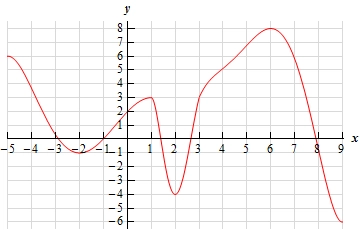
2. Below is the graph of some function, \(f\left( x \right)\). Identify all of the relative extrema and absolute extrema of the function.
Show Solution
There really isn’t all that much to this problem. We know that absolute extrema are the highest/lowest point on the graph and that they may occur at the endpoints or in the interior of the graph. Relative extrema on the other hand, are “humps” or “bumps” in the graph where in the region around that point the “bump” is a maximum or minimum. Also recall that relative extrema only occur in the interior of the graph and not at the end points of the interval.
Also recall that relative extrema can also be absolute extrema.
So, we have the following absolute/relative extrema.
Absolute Maximum : \(\left( {6,8} \right)\)
Absolute Minimum : \(\left( {9, - 6} \right)\)
Relative Maximums : \(\left( {1,3} \right)\) and \(\left( {6,8} \right)\)
Relative Minimums : \(\left( { - 2, - 1} \right)\) and \(\left( {2, - 4} \right)\)