Section 1.3 : Trig Functions
7. Determine the exact value of \(\displaystyle \cos \left( {\frac{{8\pi }}{3}} \right)\) without using a calculator.
Show All Steps Hide All Steps
Start Solution
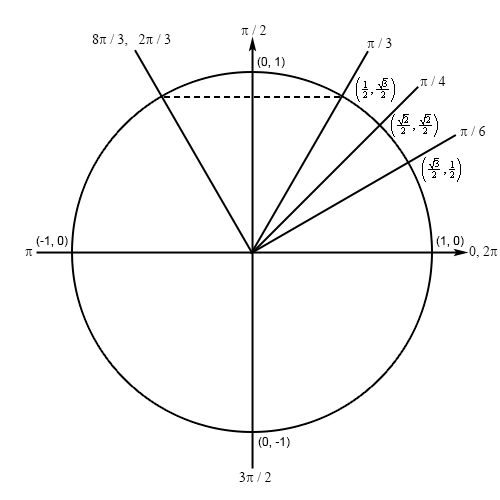
First, we can notice that \(2\pi + \frac{{2\pi }}{3} = \frac{{8\pi }}{3}\) and because \(2\pi \) is one complete revolution the angles \(\frac{{8\pi }}{3}\) and \(\frac{{2\pi }}{3}\) are the same angle. Also, note that \(\pi - \frac{\pi }{3} = \frac{{2\pi }}{3}\) and so the terminal line for \(\frac{{8\pi }}{3}\) will form an angle of \(\frac{\pi }{3}\) with the negative \(x\)-axis in the second quadrant and we’ll have the following unit circle for this problem.
Show Step 2
The coordinates of the line representing \(\frac{{8\pi }}{3}\) will be the same as the coordinates of the line representing \(\frac{\pi }{3}\) except that the \(x\) coordinate will now be negative. So, our new coordinates will then be \(\left( { - \frac{1}{2},\frac{{\sqrt 3 }}{2}} \right)\) and so the answer is,
\[\cos \left( {\frac{{8\pi }}{3}} \right) = - \frac{1}{2}\]