Section 12.4 : Quadric Surfaces
3. Sketch the following quadric surface.
\[z = \frac{{{x^2}}}{4} + \frac{{{y^2}}}{4} - 6\]Show Solution
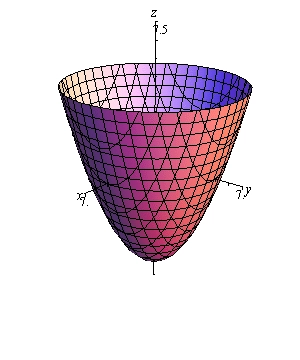
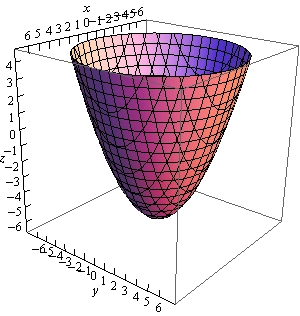
This is an elliptic paraboloid that is centered on the \(z\)-axis. Because the \(x\) and \(y\) terms are positive we know that it will open upwards. The “-6” tells us that the surface will start at \(z = - 6\). We can also say that because the coefficients of the \(x\) and \(y\) terms are identical the cross sections of the surface will be circles.
Here are a couple of sketches of the region. We’ve given them with the more traditional axes as well as “boxed” axes to help visualize the surface.