Section 15.5 : Triple Integrals
8. Use a triple integral to determine the volume of the region below \(z = 4 - xy\) and above the region in the \(xy\)-plane defined by \(0 \le x \le 2\), \(0 \le y \le 1\).
Show All Steps Hide All Steps
Start Solution
Okay, let’s start off with a quick sketch of the region we want the volume of so we can get a feel for what we’re dealing with. We’ll call this region \(E\).
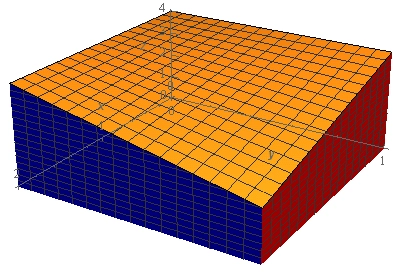
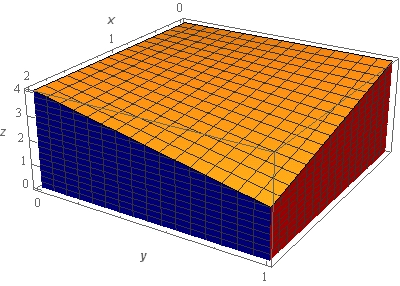
We’ve given the sketches with a set of “traditional” axes as well as a set of “box” axes to help visualize the surface and region.
The top portion of the region (the orange colored surface) is the graph of \(z = 4 - xy\). The two sides shown (the blue and red surfaces) show the two sides of the region that we can see given the orientation of the region. The bottom of the region is the \(xy\)-plane.
Show Step 2
The volume of this solid is given by,
\[V = \iiint\limits_{E}{{dV}}\]Show Step 3
So, we now need to get the limits set up for the integral. From the sketch above we know that we’ll have the following limits for \(z\).
\[0 \le z \le 4 - xy\]We’ll also need limits for \(D\). In this case that is really simple as we can see from the problem statement that \(D\) is just a rectangle in the \(xy\)-plane and in fact the limits are given in the problem statement as,
\[\begin{array}{c}0 \le x \le 2\\ 0 \le y \le 1\end{array}\]There really isn’t any advantage to doing one order vs. the other so, in this case, we’ll integrate \(y\) and then \(x\).
Now, plugging all these limits into the integral the volume is,
\[V = \iiint\limits_{E}{{dV}} = \int_{0}^{2}{{\int_{0}^{1}{{\int_{0}^{{4 - xy}}{{dz}}\,dy}}\,dx}}\]Show Step 4
Okay, now all we need to do is evaluate the integral. Here is the \(z\) integration.
\[\begin{align*}V & = \int_{0}^{2}{{\int_{0}^{1}{{\left. z \right|_0^{4 - xy}\,dy}}\,dx}}\\ & = \int_{0}^{2}{{\int_{0}^{1}{{4 - xy\,dy}}\,dx}}\end{align*}\]Show Step 5
Now let’s do the \(y\) integration.
\[\begin{align*}V & = \int_{0}^{2}{{\left. {\left( {4y - \frac{1}{2}x{y^2}} \right)} \right|_0^1\,dx}}\\ & = \int_{0}^{2}{{4 - \frac{1}{2}x\,dx}}\end{align*}\]Show Step 6
Finally, let’s do the \(x\) integration to get the volume of the region.
\[V = \iiint\limits_{E}{{dV}} = \left. {\left( {4x - \frac{1}{4}{x^2}} \right)} \right|_0^2 = \require{bbox} \bbox[2pt,border:1px solid black]{7}\]