Section 16.3 : Line Integrals - Part II
For problems 1 – 7 evaluate the given line integral. Follow the direction of \(C\) as given in the problem statement.
- Evaluate \( \displaystyle \int\limits_{C}{{xy\,dx + \left( {x - y} \right)\,dy}}\) where \(C\) is the line segment from \(\left( {0, - 3} \right)\) to \(\left( { - 4,1} \right)\).
- Evaluate \( \displaystyle \int\limits_{C}{{{{\bf{e}}^{3x}}\,dx}}\) where \(C\) is portion of \(x = \sin \left( {4y} \right)\) from \(\displaystyle y = \frac{\pi }{8}\) to \(y = \pi \).
- Evaluate \( \displaystyle \int\limits_{C}{{x\,dy - \left( {{x^2} + y} \right)\,dx}}\) where \(C\) is portion of the circle centered at the origin of radius 3 in the 2nd quadrant with clockwise rotation.
- Evaluate \( \displaystyle \int\limits_{C}{{dx - 3{y^3}\,dy}}\) where \(C\) is given by \(\vec r\left( t \right) = 4\sin \left( {\pi t} \right)\,\,\vec i + {\left( {t - 1} \right)^2}\vec j\) with \(0 \le t \le 1\).
- Evaluate \( \displaystyle \int\limits_{C}{{4{y^2}\,dx + 3x\,dy + 2z\,dz}}\) where \(C\) is the line segment from \(\left( {4, - 1,2} \right)\) to \(\left( {1,7, - 1} \right)\).
- Evaluate \( \displaystyle \int\limits_{C}{{\left( {yz + x} \right)dx + yz\,dy\, - \left( {y + z} \right)\,dz}}\) where \(C\) is given by \(\vec r\left( t \right) = 3t\,\vec i + 4\sin \left( t \right)\vec j + 4\cos \left( t \right)\,\vec k\) with \(0 \le t \le \pi \).
- Evaluate \( \displaystyle \int\limits_{C}{{7xy\,dy}}\) where \(C\) is the portion of \(y = \sqrt {{x^2} + 5} \) from \(x = - 1\) to \(x = 2\) followed by the line segment from \(\left( {2,3} \right)\) to \(\left( {4, - 1} \right)\). See the sketch below for the direction.
![This curve starts with the portion of $y=\sqrt[x^{2}+5]$ starting at $\left( -1, \sqrt[6] \right)$ and ending at (2,3) and followed by a line starting at (2,3) and ending at (4,-1).](LineIntegralsPtII_Files/image001.webp)
- Evaluate \( \displaystyle \int\limits_{C}{{\left( {{y^2} - x} \right)\,dx - 4y\,dy}}\) where \(C\) is the portion of \(y = {x^2}\) from \(x = - 2\) to \(x = 2\) followed by the line segment from \(\left( {2,4} \right)\) to \(\left( {0,6} \right)\) which in turn is followed by the line segment from \(\left( {0,6} \right)\) to \(\left( { - 2,4} \right)\). See the sketch below for the direction.
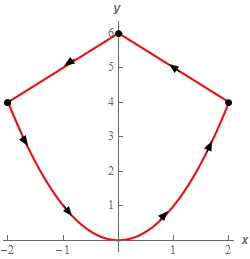
- Evaluate \( \displaystyle \int\limits_{C}{{\left( {{x^2} - 2} \right)\,dx + 7x{y^2}\,dy}}\) for each of the following curves.
- \(C\) is the portion of \(x = - {y^2}\) from \(y = - 1\) to \(y = 1\).
- \(C\) is the line segment from \(\left( { - 1, - 1} \right)\) to \(\left( {1,1} \right)\).
- Evaluate \( \displaystyle \int\limits_{C}{{{x^3} + 9y\,dy}}\) for each of the following curves.
- \(C\) is the portion of \(y = 1 - {x^2}\) from \(x = - 1\) to \(x = 1\).
- \(C\) is the line segment from \(\left( { - 1,0} \right)\) to \(\left( {0, - 1} \right)\) followed by the line segment from \(\left( {0, - 1} \right)\) to \(\left( {1,0} \right)\).
- Evaluate \( \displaystyle \int\limits_{C}{{x{y^3}\,dx - 4x\,dy}}\) for each of the following curves.
- \(C\) is the portion of the circle centered at the origin of radius 7 in the 1st quadrant with counter clockwise rotation.
- \(C\) is the portion of the circle centered at the origin of radius 7 in the 1st quadrant with clockwise rotation.