Section 4.2 : Parabolas
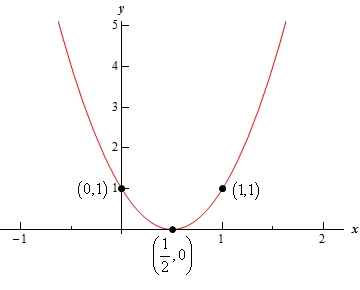
6. Sketch the graph of the following parabola. The graph should contain the vertex, the \(y\)‑intercept, \(x\)-intercepts (if any) and at least one point on either side of the vertex.
\[f\left( x \right) = 4{x^2} - 4x + 1\]Show All Steps Hide All Steps
Start Solution
Let’s find the vertex first. In this case the equation is in the form \(f\left( x \right) = a{x^2} + bx + c\). And so we know the vertex is the point \(\left( { - \frac{b}{{2a}},f\left( { - \frac{b}{{2a}}} \right)} \right)\). The vertex is then,
\[\left( { - \frac{{ - 4}}{{2\left( 4 \right)}},f\left( { - \frac{{ - 4}}{{2\left( 4 \right)}}} \right)} \right) = \left( {\frac{1}{2},f\left( {\frac{1}{2}} \right)} \right) = \left( {\frac{1}{2},0} \right)\]Also note that \(a = 4 > 0\) for this parabola and so the parabola will open upwards.
Show Step 2
The \(y\)-intercept is just the point \(\left( {0,f\left( 0 \right)} \right)\). A quick function evaluation gives us that \(f\left( 0 \right) = 1\) and so for our equation the \(y\)-intercept is \(\left( {0,1} \right)\).
Show Step 3
For the \(x\)-intercepts we would normally solve the equation \(f\left( x \right) = 0\). However, in this case we don’t need to do that. From the first step we see that the vertex has a y‑coordinate of zero and hence is also an \(x\)-intercept. Also, because it is the vertex this can be the only \(x\)-intercept for this function.
Note that if we’d solved the equation we would have also arrived at this single \(x\)‑intercept.
Show Step 4
In this case all we have are the vertex (which also happens to be the single \(x\)‑intercept) and the \(y\)-intercept (which is on the left side of the vertex). So, we’ll need a point that is on the left side of the vertex and we can find the point on the left side of the vertex that corresponds to the \(y\)-intercept for this point.
The \(y\)-intercept is a distance of 1 to the left of the vertex and so there will be a corresponding point at the same \(y\) value to the right and it will be a distance of 1 to the right of the vertex. Therefore, the point to the right of the vertex corresponding to the y‑intercept is \(\left( {1,1} \right)\).
Show Step 5
Here is a sketch of the parabola including all the points we found above.