Section 4.6 : The Shape of a Graph, Part II
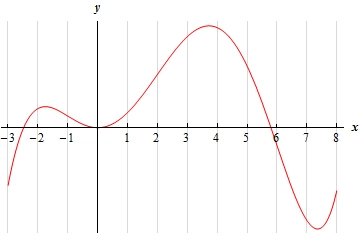
1. The graph of a function is given below. Determine the intervals on which the function is concave up and concave down.
Show Solution
There really isn’t too much to this problem. We can easily see from the graph where the function in concave up/concave down and so all we need to do is estimate where the concavity changes (and this really will be an estimate as it won’t always be clear) and write down the intervals.
\[\require{bbox} \bbox[2pt,border:1px solid black]{{{\mbox{Concave Up : }}\left( { - 1,2} \right)\,\,\,\& \,\,\,\left( {6,\infty } \right)\hspace{0.5in}{\mbox{Concave Down : }}\,\,\left( { - \infty , - 1} \right)\,\,\,\,\& \,\,\,\,\left( {2,6} \right)}}\]Again, the endpoints of these intervals are, at best, estimates as it won’t always be clear just where the concavity changes.