Section 13.6 : Chain Rule
8. Determine formulas for \(\displaystyle \frac{{\partial w}}{{\partial t}}\) and \(\displaystyle \frac{{\partial w}}{{\partial u}}\) for the following situation.
\[w = w\left( {x,y,z} \right)\hspace{0.5in}x = x\left( t \right),\,\,\,\,y = y\left( {u,v,p} \right),\,\,\,\,z = z\left( {v,p} \right),\,\,\,\,v = v\left( {r,u} \right),\,\,\,\,p = p\left( {t,u} \right)\]Show All Steps Hide All Steps
Start Solution
To determine the formula for these derivatives we’ll need the following tree diagram.
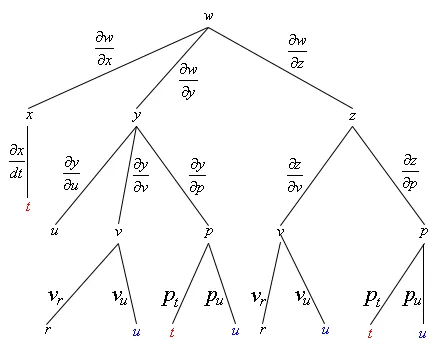
Some of these tree diagrams can get quite messy. We’ve colored the variables we’re interested in to try and make the branches we need to follow for each derivative a little clearer.
Also, because the last “row” of branches was getting a little close together we switched to the subscript derivative notation to make it easier to see which derivative was associated with each branch.
Show Step 2
Here are the formulas we’re being asked to find.
\[\frac{{\partial w}}{{\partial t}} = \frac{{\partial w}}{{\partial x}}\frac{{\partial x}}{{\partial t}} + \frac{{\partial w}}{{\partial y}}\frac{{\partial y}}{{\partial p}}\frac{{\partial p}}{{\partial t}} + \frac{{\partial w}}{{\partial z}}\frac{{\partial z}}{{\partial p}}\frac{{\partial p}}{{\partial t}}\] \[\frac{{\partial w}}{{\partial u}} = \frac{{\partial w}}{{\partial y}}\frac{{\partial y}}{{\partial u}} + \frac{{\partial w}}{{\partial y}}\frac{{\partial y}}{{\partial v}}\frac{{\partial v}}{{\partial u}} + \frac{{\partial w}}{{\partial y}}\frac{{\partial y}}{{\partial p}}\frac{{\partial p}}{{\partial u}} + \frac{{\partial w}}{{\partial z}}\frac{{\partial z}}{{\partial v}}\frac{{\partial v}}{{\partial u}} + \frac{{\partial w}}{{\partial z}}\frac{{\partial z}}{{\partial p}}\frac{{\partial p}}{{\partial u}}\]