Section 15.6 : Triple Integrals in Cylindrical Coordinates
4. Use a triple integral to determine the volume of the region below \(z = 6 - x\), above \(z = - \sqrt {4{x^2} + 4{y^2}} \) inside the cylinder \({x^2} + {y^2} = 3\) with \(x \le 0\).
Show All Steps Hide All Steps
Start Solution
Okay, let’s start off with a quick sketch of the region \(E\) so we can get a feel for what we’re dealing with.
Here then is the sketch of \(E\).
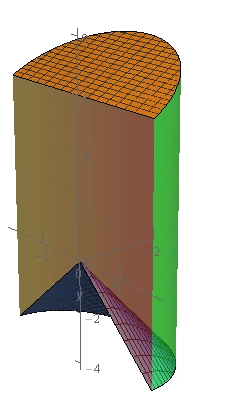
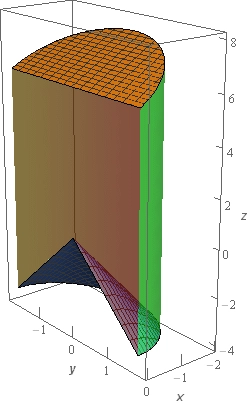
We’ve given the sketches with a set of “traditional” axes as well as a set of “box” axes to help visualize the surface and region.
The plane \(z = 6 - x\) is the top “cap” on the cylinder and the cone \(z = - \sqrt {4{x^2} + 4{y^2}} \) is the bottom “cap” on the cylinder. We only have half of the cylinder because of the \(x \le 0\) portion of the problem statement.
Show Step 2
The volume of this solid is given by,
\[V = \iiint\limits_{E}{{dV}}\]Show Step 3
So, from the sketch it is hopefully clear that the region \(D\) will be in the \(xy\)-plane and so we’ll need to integrate with respect to \(z\) first. That means that the \(z\) limits are,
\[ - \sqrt {4{x^2} + 4{y^2}} \le z \le 6 - x\]Show Step 4
For this problem \(D\) is simply the portion of the disk \({x^2} + {y^2} \le \sqrt 3 \) with \(x \le 0\). Here is a quick sketch of \(D\) to maybe help with the limits.
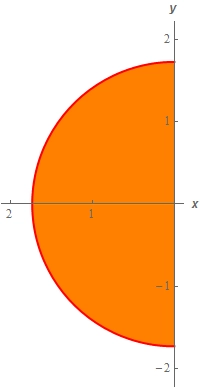
Since \(D\) is clearly a portion of a disk it makes sense that we’ll be using cylindrical coordinates. So, here are the cylindrical coordinates for this problem.
\[\begin{array}{c}\displaystyle \frac{\pi }{2} \le \theta \le \frac{{3\pi }}{2}\\ 0 \le r \le \sqrt 3 \\ - 2r \le z \le 6 - r\cos \theta \end{array}\]Don’t forget to convert the \(z\) limits into cylindrical coordinates.
Show Step 5
Plugging these limits into the integral and converting to cylindrical coordinates gives,
\[V = \iiint\limits_{E}{{\,dV}} = \int_{{\frac{\pi }{2}}}^{{\frac{{3\pi }}{2}}}{{\int_{0}^{{\sqrt 3 }}{{\int_{{ - 2r}}^{{6 - r\cos \theta }}{{r\,dz}}\,dr}}\,d\theta }}\]Don’t forget that \(dV = r\,dx\,dr\,d\theta \) and so we pick up an \(r\) when converting the \(dV\) to cylindrical coordinates.
Show Step 6
Okay, now all we need to do is evaluate the integral. Here is the \(z\) integration.
\[\begin{align*}V & = \int_{{\frac{\pi }{2}}}^{{\frac{{3\pi }}{2}}}{{\int_{0}^{{\sqrt 3 }}{{\left. {\left( {rz} \right)} \right|_{ - 2r}^{6 - r\cos \theta }\,dr}}\,d\theta }}\\ & = \int_{{\frac{\pi }{2}}}^{{\frac{{3\pi }}{2}}}{{\int_{0}^{{\sqrt 3 }}{{6r - {r^2}\cos \theta + 2{r^2}\,dr}}\,d\theta }}\end{align*}\]Show Step 7
Next let’s do the \(r\) integration.
\[\begin{align*}V & = \int_{{\frac{\pi }{2}}}^{{\frac{{3\pi }}{2}}}{{\left. {\left( {3{r^2} - \frac{1}{3}{r^3}\cos \theta + \frac{2}{3}{r^3}} \right)} \right|_0^{\sqrt 3 }\,d\theta }}\\ & = \int_{{\frac{\pi }{2}}}^{{\frac{{3\pi }}{2}}}{{9 - \sqrt 3 \cos \theta + 2\sqrt 3 \,d\theta }}\end{align*}\]Show Step 8
Finally, we’ll do the \(\theta \) integration.
\[V = \left. {\left( {9\theta + 2\sqrt 3 \theta - \sqrt 3 \sin \theta } \right)} \right|_{\frac{\pi }{2}}^{\frac{{3\pi }}{2}} = \require{bbox} \bbox[2pt,border:1px solid black]{{2\sqrt 3 + \left( {9 + 2\sqrt 3 } \right)\pi = 42.6212}}\]