Skip to main content ?

Section 3.2 : Interpretation of the Derivative

3. Sketch the graph of a function that satisfies\(f\left( 1 \right) = 3\), \(f'\left( 1 \right) = 1\), \(f\left( 4 \right) = 5\), \(f'\left( 4 \right) = - 2\).

Show All Steps Hide All Steps

Start Solution

First, recall that one of the interpretations of the derivative is that it is the slope of the tangent line to the function at a particular point. So, let’s start off with a graph that has the given points on it and a sketch of a tangent line at the points whose slope is the value of the derivative at the points.
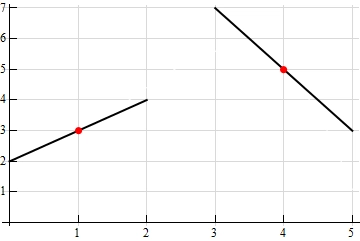
A sketch showing just the two given points and the tangent lines at those points.  The point \(\left( {1,3} \right)\) is marked with a dot and has a short line through it rising to the right with a slope of 1, and the point \(\left( {4,5} \right)\) is marked with a dot and has a short line through it falling to the right with a slope of -2.
Show Step 2

Now, all that we need to do is sketch in a graph that goes through the indicated points and at the same time it must be parallel to the tangents that we sketched. There are many possible sketches that we can make here and so don’t worry if your sketch is not the same as the one here. This is just one possible sketch that meets the given conditions.
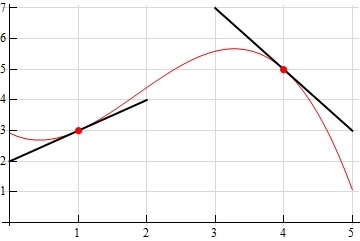
A sketch of a function that satisfies the given conditions, drawn in with the two points and their tangent lines.  The curve passes through \(\left( {1,3} \right)\) rising and parallel to the tangent line there, continues up to a peak between \(x = 3\) and \(x = 4\), and then comes back down through \(\left( {4,5} \right)\) parallel to the falling tangent line there.

While, it’s not really needed here is a sketch of the function without all the extra bits that we put in to help with the sketch.
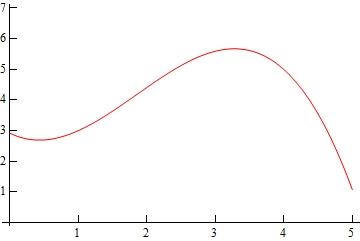
A sketch of a function that satisfies the given conditions with the points and tangent lines removed.  The curve starts near \(\left( {0,3} \right)\), dips to a shallow valley just after that, rises through \(\left( {1,3} \right)\) up to a peak near \(x = 3.3\) and then falls off to about \(\left( {5,1} \right)\) at the right end.