Section 16.2 : Line Integrals - Part I
4. Evaluate \( \displaystyle \int\limits_{C}{{xy - 4z\,ds}}\) where \(C\) is the line segment from \(\left( {1,1,0} \right)\) to \(\left( {2,3, - 2} \right)\).
Show All Steps Hide All Steps
Start Solution
Here is a quick sketch of \(C\) with the direction specified in the problem statement shown.
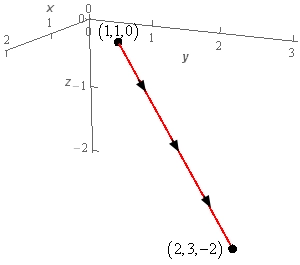
Show Step 2
We know how to get the parameterization of a line segment so let’s just jump straight into the parameterization of the line segment.
\[\vec r\left( t \right) = \left( {1 - t} \right)\left\langle {1,1,0} \right\rangle + t\left\langle {2,3, - 2} \right\rangle = \left\langle {1 + t,1 + 2t, - 2t} \right\rangle \,\,\,\,\,\,\,\,0 \le t \le 1\]We could also break this up into parameter form as follows.
\[\begin{array}{*{20}{l}}{x = 1 + t}\\{y = 1 + 2t}\\{z = - 2t}\end{array}\hspace{0.25in}0 \le t \le 1\]Either form of the parameterization will work for the problem but we’ll use the vector form for the rest of this problem.
Show Step 3
We’ll need the magnitude of the derivative of the parameterization so let’s get that.
\[\vec r'\left( t \right) = \left\langle {1,2, - 2} \right\rangle \hspace{0.25in}\hspace{0.25in}\left\| {\vec r'\left( t \right)} \right\| = \sqrt {{{\left( 1 \right)}^2} + {{\left( 2 \right)}^2} + {{\left( { - 2} \right)}^2}} = \sqrt 9 = 3\]We’ll also need the integrand “evaluated” at the parameterization. Recall all this means is we replace the \(x\)/\(y\) in the integrand with the \(x\)/\(y\) from parameterization. Here is the integrand evaluated at the parameterization.
\[xy - 4z = \left( {1 + t} \right)\left( {1 + 2t} \right) - 4\left( { - 2t} \right) = 2{t^2} + 11t + 1\]Show Step 4
The line integral is then,
\[\int\limits_{C}{{xy - 4z\,ds}} = \int_{0}^{1}{{\left( {2{t^2} + 11t + 1} \right)\left( 3 \right)\,dt}} = \left. {3\left( {\frac{2}{3}{t^3} + \frac{{11}}{2}{t^2} + t} \right)} \right|_0^1 = \require{bbox} \bbox[2pt,border:1px solid black]{{\frac{{43}}{2}}}\]