Section 16.3 : Line Integrals - Part II
3. Evaluate \( \displaystyle \int\limits_{C}{{{x^2}\,dy - yz\,dz}}\) where \(C\) is the line segment from \(\left( {4, - 1,2} \right)\) to \(\left( {1,7, - 1} \right)\).
Show All Steps Hide All Steps
Start Solution
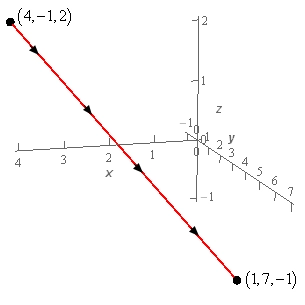
Here is a quick sketch of \(C\) with the direction specified in the problem statement shown.
Show Step 2
Next, we need to parameterize the curve.
\[\vec r\left( t \right) = \left( {1 - t} \right)\left\langle {4, - 1,2} \right\rangle + t\left\langle {1,7, - 1} \right\rangle = \left\langle {4 - 3t, - 1 + 8t,2 - 3t} \right\rangle \hspace{0.25in}0 \le t \le 1\]Show Step 3
Now we need to evaluate the line integral. Be careful with this type of lines integral. In this case we have both a \(dy\) and a \(dz\) in the integrand. Recall that this is just a simplified notation for,
\[\int\limits_{C}{{{x^2}\,dy - yz\,dz}} = \int\limits_{C}{{{x^2}\,dy}} - \int\limits_{C}{{yz\,dz}}\]Then all we need to do is recall that \(dy = y'\,dt\) and \(dz = z'\,dt\) when we convert the line integral into a “standard” integral.
So, let’s evaluate the line integral. Just remember to “plug in” the parameterization into the integrand (i.e. replace the \(x\), \(y\) and \(z\) in the integrand with the \(x\), \(y\) and \(z\) components of the parameterization) and to convert the differentials properly.
Here is the line integral.
\[\begin{align*}\int\limits_{C}{{{x^2}\,dy - yz\,dz}} & = \int\limits_{C}{{{x^2}\,dy}} - \int\limits_{C}{{yz\,dz}}\\ & = \int_{0}^{1}{{{{\left( {4 - 3t} \right)}^2}\left( 8 \right)\,dt}} - \int_{0}^{1}{{\left( { - 1 + 8t} \right)\,\,\left( {2 - 3t} \right)\left( { - 3} \right)\,dt}}\\ & = \int_{0}^{1}{{8{{\left( {4 - 3t} \right)}^2} - 3\left( {24{t^2} - 19t + 2\,dt} \right)\,dt}}\\ & = \left. {\left[ { - \frac{8}{9}{{\left( {4 - 3t} \right)}^3} - 3\left( {8{t^3} - \frac{{19}}{2}t^{2} + 2t} \right)} \right]} \right|_0^1 = \require{bbox} \bbox[2pt,border:1px solid black]{{\frac{{109}}{2}}}\end{align*}\]Note that, in this case, we combined the two integrals into a single integral prior to actually evaluating the integral. This doesn’t need to be done but can, on occasion, simplify the integrand and hence the evaluation of the integral.