Section 3.2 : Interpretation of the Derivative
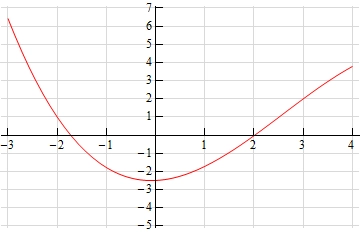
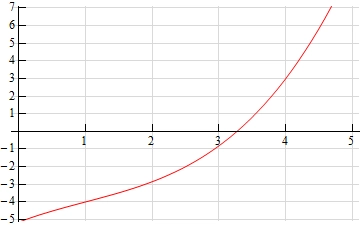
For problems 1 and 2 use the graph of the function, \(f\left( x \right)\), estimate the value of \(f'\left( a \right)\) for the given values of \(a\).
For problems 3 and 4 sketch the graph of a function that satisfies the given conditions.
- \(f\left( 1 \right) = 3\), \(f'\left( 1 \right) = 1\), \(f\left( 4 \right) = 5\), \(f'\left( 4 \right) = - 2\) Solution
- \(f\left( { - 3} \right) = 5\), \(f'\left( { - 3} \right) = - 2\), \(f\left( 1 \right) = 2\), \(f'\left( 1 \right) = 0\), \(f\left( 4 \right) = - 2\), \(f'\left( 4 \right) = - 3\) Solution
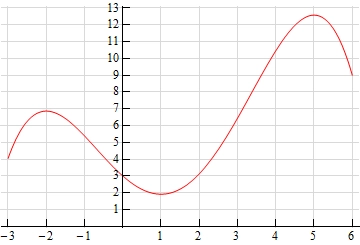
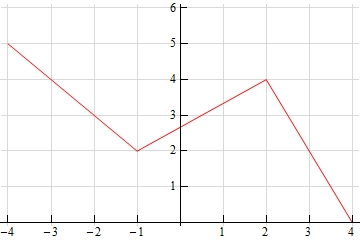
For problems 5 and 6 the graph of a function, \(f\left( x \right)\), is given. Use this to sketch the graph of the derivative, \(f'\left( x \right)\).
-
Solution
-
Solution
- Answer the following questions about the function \(W\left( z \right) = 4{z^2} - 9z\).
- Is the function increasing or decreasing at \(z = - 1\)?
- Is the function increasing or decreasing at \(z = 2\)?
- Does the function ever stop changing? If yes, at what value(s) of \(z\) does the function stop changing?
- What is the equation of the tangent line to \(f\left( x \right) = 3 - 14x\) at \(x = 8\). Solution
- The position of an object at any time \(t\) is given by \(\displaystyle s\left( t \right) = \frac{{t + 1}}{{t + 4}}\).
- Determine the velocity of the object at any time \(t\).
- Does the object ever stop moving? If yes, at what time(s) does the object stop moving?
- What is the equation of the tangent line to \(\displaystyle f\left( x \right) = \frac{5}{x}\) at \(\displaystyle x = \frac{1}{2}\)? Solution
- Determine where, if anywhere, the function \(g\left( x \right) = {x^3} - 2{x^2} + x - 1\) stops changing. Solution
- Determine if the function \(Z\left( t \right) = \sqrt {3t - 4} \) increasing or decreasing at the given points.
- \(t = 5\)
- \(t = 10\)
- \(t = 300\)
- Suppose that the volume of water in a tank for\(0 \le t \le 6\) is given by \(Q\left( t \right) = 10 + 5t - {t^2}\).
- Is the volume of water increasing or decreasing at \(t = 0\)?
- Is the volume of water increasing or decreasing at \(t = 6\)?
- Does the volume of water ever stop changing? If yes, at what times(s) does the volume stop changing?