Section 4.6 : The Shape of a Graph, Part II
Section 1-1 : The Shape of a Graph, Part I- The graph of a function is given below. Determine the intervals on which the function is concave up and concave down.
Solution
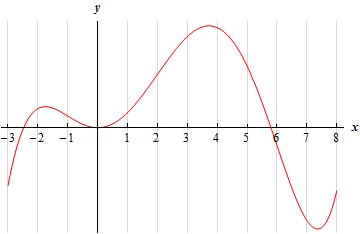
- Below is the graph the 2nd derivative of a function. From this graph determine the intervals in which the function is concave up and concave down.
Solution
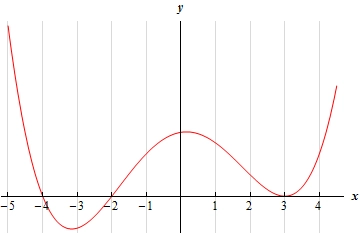
For problems 3 – 8 answer each of the following.
- Determine a list of possible inflection points for the function.
- Determine the intervals on which the function is concave up and concave down.
- Determine the inflection points of the function.
- \(f\left( x \right) = 12 + 6{x^2} - {x^3}\) Solution
- \(g\left( z \right) = {z^4} - 12{z^3} + 84z + 4\) Solution
- \(h\left( t \right) = {t^4} + 12{t^3} + 6{t^2} - 36t + 2\) Solution
- \(h\left( w \right) = 8 - 5w + 2{w^2} - \cos \left( {3w} \right)\) on \(\left[ { - 1,2} \right]\) Solution
- \(R\left( z \right) = z{\left( {z + 4} \right)^{\,{\frac{2}{3}}}}\) Solution
- \(h\left( x \right) = {{\bf{e}}^{4 - {x^{\,2}}}}\) Solution
For problems 9 – 14 answer each of the following.
- Identify the critical points of the function.
- Determine the intervals on which the function increases and decreases.
- Classify the critical points as relative maximums, relative minimums or neither.
- Determine the intervals on which the function is concave up and concave down.
- Determine the inflection points of the function.
- Use the information from steps (a) – (e) to sketch the graph of the function.
- \(g\left( t \right) = {t^5} - 5{t^4} + 8\) Solution
- \(f\left( x \right) = 5 - 8{x^3} - {x^4}\) Solution
- \(h\left( z \right) = {z^4} - 2{z^3} - 12{z^2}\) Solution
- \(Q\left( t \right) = 3t - 8\sin \left( {{\displaystyle \frac{t}{2}}} \right)\) on \(\left[ { - 7,4} \right]\) Solution
- \(f\left( x \right) = {x^{\,{\frac{4}{3}}}}\left( {x - 2} \right)\) Solution
- \(P\left( w \right) = w{{\bf{e}}^{4w}}\) Solution
- Determine the minimum degree of a polynomial that has exactly one inflection point. Solution
- Suppose that we know that \(f\left( x \right)\) is a polynomial with critical points \(x = - 1\), \(x = 2\) and \(x = 6\). If we also know that the 2nd derivative is \(f''\left( x \right) = - 3{x^2} + 14x - 4\). If possible, classify each of the critical points as relative minimums, relative maximums. If it is not possible to classify the critical points clearly explain why they cannot be classified. Solution