Section 15.3 : Double Integrals over General Regions
- Evaluate\( \displaystyle \iint\limits_{D}{{42{y^2} - 12x\,dA}}\) where \(D = \left\{ {\left( {x,y} \right)|0 \le x \le 4,{{\left( {x - 2} \right)}^2} \le y \le 6} \right\}\) Solution
- Evaluate \( \displaystyle \iint\limits_{D}{{2y{x^2} + 9{y^3}\,dA}}\) where \(D\) is the region bounded by \( \displaystyle y = \frac{2}{3}x\) and \(y = 2\sqrt x \). Solution
- Evaluate \( \displaystyle \iint\limits_{D}{{10{x^2}{y^3} - 6\,dA}}\) where \(D\) is the region bounded by \(x = - 2{y^2}\) and \(x = {y^3}\). Solution
- Evaluate \( \displaystyle \iint\limits_{D}{{x\left( {y - 1} \right)\,dA}}\) where \(D\) is the region bounded by \(y = 1 - {x^2}\) and \(y = {x^2} - 3\). Solution
- Evaluate \( \displaystyle \iint\limits_{D}{{5{x^3}\cos \left( {{y^3}} \right)\,dA}}\) where \(D\) is the region bounded by \(y = 2\), \( \displaystyle y = \frac{1}{4}{x^2}\) and the \(y\)-axis. Solution
- Evaluate \( \displaystyle \iint\limits_{D}{{\frac{1}{{{y^{\frac{1}{3}}}\left( {{x^3} + 1} \right)}}\,dA}}\) where \(D\) is the region bounded by \(x = - {y^{\frac{1}{3}}}\), \(x = 3\) and the \(x\)-axis. Solution
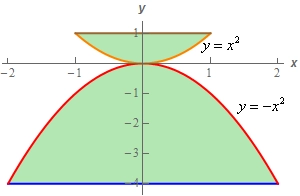
- Evaluate \( \displaystyle \iint\limits_{D}{{3 - 6xy\,dA}}\) where \(D\) is the region shown below.
Solution
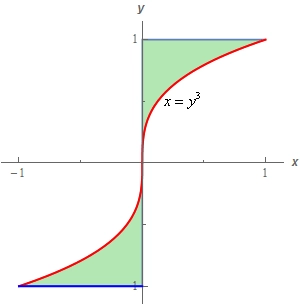
- Evaluate \(\iint\limits_{D}{{{{\bf{e}}^{\,{y^{\,4}}}}\,dA}}\) where \(D\) is the region shown below.
Solution
- Evaluate \( \displaystyle \iint\limits_{D}{{7{x^2} + 14y\,dA}}\) where \(D\) is the region bounded by \(x = 2{y^2}\) and \(x = 8\) in the order given below.
- Integrate with respect to \(x\) first and then \(y\).
- Integrate with respect to \(y\) first and then \(x\).
For problems 10 & 11 evaluate the given integral by first reversing the order of integration.
- \( \displaystyle \int_{0}^{3}{{\int_{{2x}}^{6}{{\sqrt {{y^2} + 2} \,dy}}\,dx}}\) Solution
- \( \displaystyle \int_{0}^{1}{{\int_{{ - \sqrt y }}^{{{y^{\,2}}}}{{6x - y\,dx}}\,dy}}\) Solution
- Use a double integral to determine the area of the region bounded by \(y = 1 - {x^2}\) and \(y = {x^2} - 3\). Solution
- Use a double integral to determine the volume of the region that is between the \(xy\)‑plane and\(f\left( {x,y} \right) = 2 + \cos \left( {{x^2}} \right)\) and is above the triangle with vertices \(\left( {0,0} \right)\), \(\left( {6,0} \right)\) and \(\left( {6,2} \right)\). Solution
- Use a double integral to determine the volume of the region bounded by \(z = 6 - 5{x^2}\) and the planes \(y = 2x\), \(y = 2\),\(x = 0\) and the \(xy\)-plane. Solution
- Use a double integral to determine the volume of the region formed by the intersection of the two cylinders \({x^2} + {y^2} = 4\) and \({x^2} + {z^2} = 4\). Solution